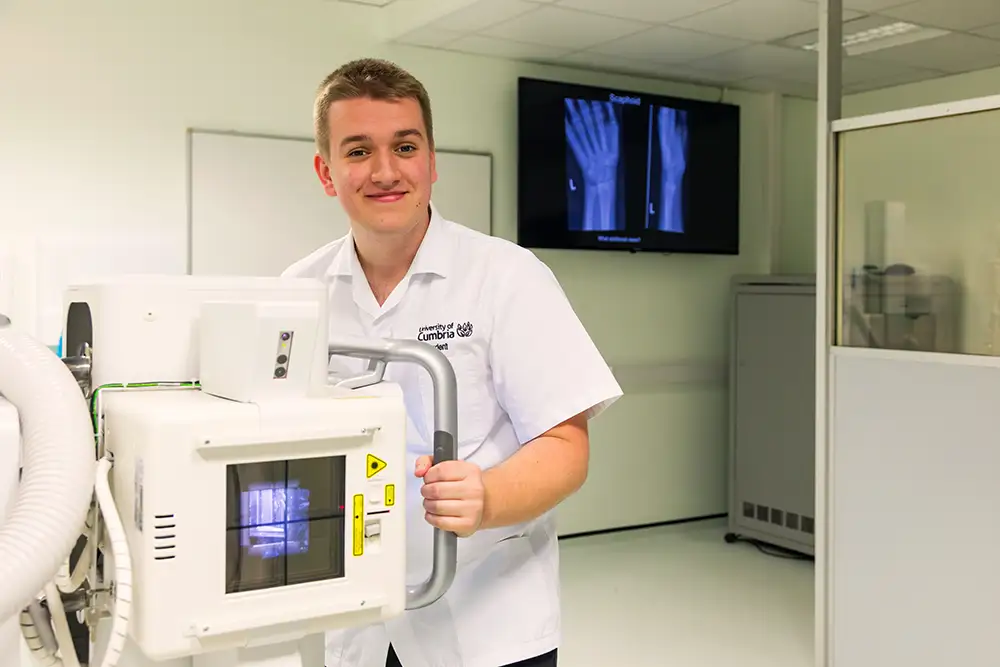
This Apprenticeship allows qualified assistant practitioners working in the field of medical imaging to progress their existing qualification to a full BSc Honours Degree in Diagnostic Radiography. They will then be eligible to apply to the HCPC to enter their register as a Diagnostic Radiographer.
Graduates are eligible to apply to the HCPC to register as a Diagnostic Radiographer on successful completion of the programme. Other career avenues may include research, teaching, working with medical imaging equipment manufacturers or healthcare management.
Accredited by:
The Health and Care Professions Council (HCPC)
Course Overview
This Apprenticeship is intended for assistant practitioners who have already achieved a relevant foundation degree and are employed in a medical imaging setting. The applicant must be working in a medical imaging department with the full support of their employer to undertake the apprenticeship. This apprenticeship combines work-based learning in order to progress clinical skills and behaviours with academic study to develop knowledge relevant to this field of work.
Apprentices will continue to work an an employee at their place of work while undertaking this apprenticeship, with time being allocated by their employer to allow them to meet necessary academic and clinical competencies. This includes a minimum of 20% 'off-the-job' training time to cover both university study time and clinical skills outside of the apprentice's usual scope of practice.
On this course you will...
Develop your interest, knowledge and understanding of the continually changing and expanding field of medical diagnostic imaging.
Enable you to learn in both the academic and clinical settings demonstrating levels of achievement whilst being supported within those environments.
Graduate with a realistic and professional attitude to the current working environment and an understanding of the dynamic and changing nature of your clinical role.
Graduate as a resilient, proficient communicators whose values are centred around effective and compassionate patient care.
Continue learning throughout your professional life (CPD) assuring a competent, informed member of the healthcare team.
Engage in safe and effective practice.
Course Structure
What you will learn
There are 2 elements to this apprenticeship; Apprentices will initially undergo an assessment of prior learning which will determine which elements of the apprenticeship they will need to study.
Radiographer AP Bridging Course
Most apprentices will be required to take the Radiographer AP Bridging course before progressing onto the Top-Up course. The purpose of this element is to prepare apprentices for level 6 study and to ensure they meet the necessary professional body and apprenticeship standards.
Diagnostic Radiography (Top-Up)
The Diagnostic Radiography (Top-Up) will allow students to gain the remaining knowledge and skills required to apply for registration with the HCPC as a diagnostic radiographer.
Teaching & Assessment
How you will learn
Radiographer AP Bridging This UDip programme forms the first element to the Diagnostic Radiography (AP Progression) Apprenticeship. Throughout this you will meet relevant competencies to bring you up to the same level as an end of 2nd year BSc (Hons) Diagnostic Radiography student. Prior to starting, you will complete an ‘individual learning needs analysis’ (ILNA). This comprehensive document highlights knowledge and skills that apprentices already have and those that need to be developed. It is expected that different APs will have different areas for development and so this document will identify your learning goals for the course and we will tailor your learning accordingly.
This programme (which this programme specification relates to) follows directly on from the bridging as the second element in the Diagnostic Radiography (AP Progression) Apprenticeship. It broadly follows the modules and content of the 3rd year of an undergraduate Diagnostic Radiography BSc (Hons) degree. Where it differs is in its delivery, which is planned around work-based learning and will fit in teaching sessions around work.
How you will be assessed
A variety of different assessment methods are employed to provide a valid evaluation of the particular skills, knowledge and behaviours described in the professional body and Diagnostic Radiographer Apprenticeship standard. For example, Image evaluation and pathology recognition are assessed by computer-based assessments in which you are required to view and discuss images. Your interpretation of complex clinical scenarios will be assessed via oral examinations which develop and challenge your ability to hold professional discussions with service users and colleagues in both the medical imaging sessions and the wider interdisciplinary context. The application of research module will challenge you to critically review practice and challenge poor practice within medical imaging and use the latest research and evidence in order to allow you to formulate persuasive arguments. This will enable you to make recommendations to enhance service provision and patient care.
Career Outcomes
Graduates are eligible to apply to the HCPC to register as a Diagnostic Radiographer on successful completion of the programme. Other career avenues may include research, teaching, working with medical imaging equipment manufacturers or healthcare management.
Overview
Grade C/4 GCSE or equivalent (eg. Functional skills level 2) in Maths and English. You need to be an assistant practitioner working in a medical imaging department.
Qualifications
Entry Requirements
GCSEs: Grade C/4 GCSE or equivalent (eg. Functional skills level 2) in Maths and English.
Selection Criteria
You need to be an assistant practitioner working in a medical imaging department. Candidates will be interviewed.Evidence of prior qualifications and experience will be requested.
For information about Medical Clearance and vaccination requirements (including Covid-19 Vaccines) click here.
Employer selection criteria:
All apprentices must be interviewed, assessed and offered a position by an employer before being admitted to the apprenticeship programme. Although the University may receive direct enquires and filter these before passing to prospective employers, apprentices must apply directly via an employer.
The employer is responsible for the final decision in terms of who is suitable to be put forward as an apprentice from within their organisation.
Contextual Admissions
Not applicable to apprenticeships.
Fees & Funding
Tuition Fees
UK Tuition fees
International Tuition fees
Tuition fees are set annually and are subject to review each year. The University may therefore raise tuition fees in the second or subsequent years of a course, in line with inflation and/or the maximum permitted by law or Government policy. Students will be notified of any changes as soon as possible.
Funding
Degree apprenticeships are only offered to students undertaking the course as part of their employment. The apprenticeship training is therefore funded by the employer using their apprenticeship levy, with or without a contribution depending on the size and status of the organisation. Apprentices will not be required to pay any fees and will not be eligible for Student Finance England maintenance support as they are in receipt of a salary. See further information on our Information for Aspiring Apprentices page.
The University will typically charge the maximum fee for the standard, before applying reductions based on accepted prior learning which is determined at application on an individual basis. To discuss sponsoring a learner on programme please contact apprenticeships@cumbria.ac.uk.
More Information
We have a wide range of scholarships, bursaries, grants and funds available to support you throughout your studies with us. This includes the Cumbria Bursary - a non-repayable bursary designed to support first year students with a household income of less than £25,000..
You should budget for stationery and consumables for personal use. These may include notebooks, pens and pencils, digital storage devices, printing and photocopying. The amount you spend will depend on your study preferences.
Books and journals
Approximately £50 to £300 over the course of your studies
Optional · Throughout the course · Books and journals
Most core textbooks and journals are available through the University library. You may choose to purchase personal copies of books or other resources used to support your studies.
Some courses recommend particular books or provide an estimated annual budget for purchasing personal copies. Search for your course below for details.
Technology requirements
Cost depends on the equipment and internet service you choose
Required · Throughout the course · Digital learning and IT
You will need regular access to a laptop or computer capable of accessing the internet and running software such as a word processor and Microsoft Teams. Microsoft 365 is provided as part of your studies. You will also need a reliable internet connection. The amount you spend will depend on the equipment and internet service you choose.
Lancaster is the Red Rose heartland, a student haven full of history and culture. With iconic stone architecture, parkland, and a caring community, this is the place to get involved. The campus houses top-quality facilities tailored to the needs of life-savers, world changers, and future leaders.
Online learning at the University of Cumbria is an interactive experience that makes use of a range of technologies and media types to provide a rich learning environment.
An Open Day is your opportunity to explore one of 5 campuses, meet your lecturers, and find out how the University of Cumbria could become your new home.